Skip to content


Understanding the Legal Weight of an Invoice: Is It Automatically a Contract?
Definition of an Invoice vs. Definition of a Contract
An invoice is a commercial document that itemizes goods or services and requests payment. For a deep dive into what an invoice is, see our in-depth guide here. By contrast, a contract is a legally enforceable promise between two or more parties that the law recognizes as creating obligations.
In everyday business, the two instruments often travel together, yet they serve different legal purposes:
• An invoice records a transaction that has already occurred or will occur imminently; a contract establishes the rules that govern the transaction before, during, and sometimes after performance.
• A contract always contains mutual assent (offer and acceptance), consideration, and intent to create legal relations. An invoice may reflect these elements, but they are not inherent to the document.
• Courts treat a signed, negotiated agreement as a binding “invoice contract,” whereas an unsigned bill generated by a free invoice generator is usually evidence—not proof—of the agreement.
Put simply, is an invoice a contract ? an invoice on its own is not intrinsically a contract; whether it becomes an enforceable invoice agreement depends on additional factors explained below.
Key Legal Elements an Invoice Must Meet to Become a Binding Agreement
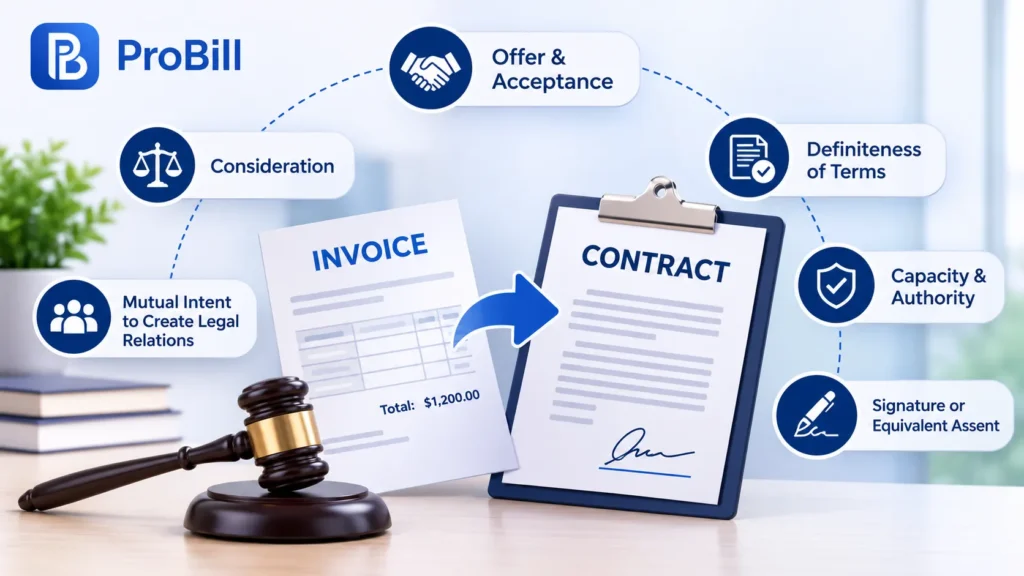
For an invoice to carry the same legal weight as a written contract, it needs to satisfy the classic contract-law checklist:
Offer & Acceptance
• The invoice must clearly state the offer (scope, price, delivery terms) and be explicitly accepted—often by signature, email confirmation, or payment of a deposit. Without acceptance, it is merely a request for payment.Consideration
• Both parties must exchange value. The seller’s promise to supply the goods or services and the buyer’s promise to pay meet this requirement; the invoice should capture both promises.Mutual Intent to Create Legal Relations
• Phrases such as “This invoice forms part of the governing agreement” or reference to overarching invoice terms and conditions help show legal intent. Absent that language, courts may view the invoice as informational only.Definiteness of Terms
• Key details—product description, quantity, price, delivery timeline, and payment schedule—must be unambiguous. Our curated invoice templates ensure each essential term appears consistently.Capacity & Authority
• Both parties must possess legal capacity, and the signatories must have authority to bind their organizations. This is especially important when you bill specialized sectors; our invoice resources by industry outline sector-specific authority pitfalls.Signature or Equivalent Assent
• A handwritten or digital signature, a secure e-signature platform, or unequivocal conduct (e.g., partial payment) can signal acceptance. Under the U.S. Uniform Electronic Transactions Act and the UCC §2-201, electronic signatures usually suffice. See the Uniform Law Commission’s commentary for details .
If any one of these elements is missing, the invoice may still support a breach-of-contract claim, but it will not, by itself, function as the complete invoice contract. Businesses can avoid ambiguity by integrating the invoice into a master services agreement, attaching detailed terms, and using the Create Invoice platform to embed acceptance fields.
Remember, when you clarify terms up front and document acceptance, an ordinary invoice can rise to the level of a binding invoice agreement—saving you from costly disputes over payment or performance.
Scenarios Where an Invoice Becomes an Enforceable Invoice Contract
Purchase Orders & Accepted Quotes: Turning Paperwork into Obligations

A quote accepted by the buyer, followed by a matching purchase order (PO), sets the stage for an enforceable invoice contract. Once the seller issues an invoice that expressly references the PO or the signed quote, the paperwork chain evidences mutual assent and consideration—two pillars of any invoice agreement.
- Seller issues a detailed quote, often built from customizable invoice templates.
- Buyer signs or emails “approved,” constituting acceptance.
- Buyer’s purchasing team generates a PO mirroring the quote’s price, quantity, and delivery terms.
- Seller ships goods or performs services and then sends an invoice that cross-references the PO and embeds key invoice terms and conditions.
- Buyer acknowledges receipt or pays a deposit, finalizing the invoice contract.
Courts view this sequence as a “battle-of-the-forms” resolved under UCC §2-207; conflicting boilerplate is knocked out, but the essential terms survive (see Cornell Law School’s analysis). Because the PO and invoice speak the same language, the seller can sue for the balance due without proving a separate agreement. Using a free invoice generator to auto-populate PO references reduces clerical errors that otherwise weaken enforceability. Industry nuances—construction retainage, medical device lot numbers, or software license keys—are covered in our invoice resources by industry, ensuring sector-specific POs still crystallize into a valid invoice agreement.
Implied Contracts: How Conduct Can Convert an Invoice into a Contract
Even without a PO or signature, conduct can transform an invoice into a binding invoice contract. Under the common-law doctrine of implied-in-fact agreements and Restatement (Second) of Contracts §69, silence combined with performance equals acceptance.
Typical behaviors that create an implied invoice agreement:
• Taking delivery of goods without objection.
• Using the services rendered, e.g., publishing delivered design assets.
• Making a partial payment within the invoice’s stated net-30 window.
• Failing to contest the charges after receiving a detailed statement outlining what an invoice should include.
Courts infer assent because a reasonable business would reject or return unwanted goods rather than quietly benefit (see Restatement commentary cited in American Law Reports). To shore up the invoice contract, include language such as “Use of delivered materials constitutes acceptance” and timestamp delivery through the Create Invoice dashboard. Automated read-receipt logs and time-stamped emails provide the digital paper trail judges increasingly rely on when determining whether an implied contract exists.
Protecting Your Business: Drafting Invoices That Double as Contracts
A thoughtfully drafted invoice can do more than request payment—it can lock in a full-blown invoice contract that protects cash flow and scope. When every critical promise sits on the face of the bill, you gain an instant trail of evidence if a client backtracks. Use the tactics below to convert a simple bill into a binding invoice agreement without hiring an army of lawyers.
Must-Include Clauses: Payment Terms, Deliverables, Dispute Resolution
Leaving key language to chance is the fastest way to sink an invoice contract. Every billing document should carry three rock-solid clauses:
- Payment Terms
• State currency, schedule (e.g., Net 30), late-fee formula, and preferred method. Reference your standard invoice terms and conditions so courts see a single integrated invoice agreement rather than loose paperwork. - Deliverables & Scope
• List what you will hand over, who will approve it, and the timeline. Itemizing through our invoice templates keeps language uniform while still letting you tailor fields via the free invoice generator. Precision here prevents “scope creep” disputes that can void an invoice contract. - Dispute Resolution
• Specify governing law, forum, and whether mediation or arbitration comes first. Clients who ignore the clause risk paying your collection costs, a deterrent most small businesses welcome.
Add supporting details—tax treatment, license rights, or confidentiality—only if they are truly material; overstuffing invites contradictions. For industry-specific quirks (e.g., construction retainage or SaaS uptime credits), consult our curated invoice resources by industry before finalizing the invoice agreement.
Electronic Invoices & E-Signatures: Creating a Valid Invoice Agreement Online
Digital delivery doesn’t dilute enforceability; under the U.S. ESIGN Act and the Uniform Electronic Transactions Act, an electronic signature “may not be denied legal effect” solely because it is electronic (see the statutory text ). Follow this quick protocol to seal an online invoice contract:
- Build the invoice in Create Invoice , Probill mobile app or any secure platform that time-stamps edits.
- Insert an e-signature block—or require the client to click “Accept.” Ensure the acceptance box sits directly beneath the key clauses so assent is unmistakable.
- Auto-send a confirmation email summarizing the signed terms. Courts treat the combined records as a single invoice agreement under Federal Rule of Evidence 1001.
- Archive the PDF and the audit log; both serve as self-authenticating business records if litigation erupts.
Because clients often pay from mobile devices, keep paragraphs short and highlight late-fee triggers. According to Adobe’s 2026 Digital Economy Index, 51 percent of B2B payments now originate on smartphones—meaning a frictionless clickwrap can decide whether your invoice contract is accepted in minutes or ignored for weeks.
Finally, verify that your e-signature provider uses cryptographic hashing and meets ISO 27001 standards; tamper-evident logs make it much harder for a debtor to claim “I never agreed.” Combine that security layer with the itemization checklist in what an invoice should include and the definitional clarity outlined in what an invoice is to produce an airtight, court-ready invoice contract every time.
When an Invoice Is NOT a Contract—and What to Do Next
An invoice contract fails to materialize whenever the billing document lacks clear assent, consideration, or definite terms. Recognizing those gaps quickly lets you pivot and secure a proper invoice agreement before money—or goodwill—slips away.
Common Mistakes That Weaken Enforceability
Even a well-designed bill can collapse as evidence of an invoice contract if you trip over these frequent pitfalls:
• Missing acceptance trail. Sending a PDF without a signature box or clickwrap leaves no proof the buyer agreed—silence alone rarely forms an invoice agreement under UCC §2-204.
• Vague or omitted essentials. If delivery dates, quantities, or late-fee triggers are absent, courts treat the document as a price memo. Run every draft through the checklist in what an invoice should include to close those gaps.
• Conflicting boilerplate. Attaching generic purchase terms that clash with embedded invoice terms and conditions can cancel both sets out, leaving nothing enforceable.
• Unauthorized signatory. A junior employee without authority cannot bind the company, a misstep the FTC flags as a top B2B fraud vector (see its guidance for small businesses).
• Post-performance edits. Revising totals after services are delivered looks like a unilateral change, not a mutual promise, undermining the alleged invoice contract.
Avoiding these errors starts with standardized invoice templates generated inside the free invoice generator, which locks critical language before you hit “send.”
Steps to Formalize an Agreement After an Invoice Is Sent
If you already dispatched the bill and spot any of the red flags above, take these actions—fast—to transform the paperwork into a binding invoice contract:
- Verify intent: Email the client requesting written confirmation that the invoice reflects the full deal. A simple “Reply YES to accept” often suffices.
- Issue a short-form addendum: Using Create Invoice, append a one-page rider that restates scope, price, and governing law, then references the original invoice by number.
- Attach standard clauses: Insert your curated invoice terms and conditions and any sector-specific provisions pulled from our invoice resources by industry.
- Capture e-signatures: Route the combined packet through an ESIGN-compliant platform; digital signatures are valid in all U.S. states under the Uniform Electronic Transactions Act.
- Update the invoice file: Regenerate the document via the free invoice generator so the acceptance stamp and hash values embed directly into the PDF metadata.
- Archive and notify: Store the signed file alongside the audit log, then send the client a final copy. This dual record will substantiate the invoice agreement if payment stalls.
By following these steps, you convert an uncertain bill into a defensible invoice contract, preserving both revenue and the relationship.
Frequently Asked Questions About Invoices and Contracts
Can I sue based solely on an unpaid invoice?
Yes—if the invoice reads like an invoice contract. Courts want proof of offer, acceptance, consideration, and definite payment terms. When your bill includes clear invoice terms and conditions and the buyer accepted them—by signature, email, or partial payment—you can generally file a breach-of-contract claim without drafting anything else. Use the free invoice generator to embed acceptance fields so the unpaid balance becomes enforceable as an invoice agreement.
Do I need a separate contract if my invoice already lists terms?
Not necessarily. An itemized bill that incorporates key clauses—scope, price, delivery window, late-fee formula—can double as an invoice contract when paired with explicit assent from the client. Leveraging standardized invoice templates helps ensure no essential term is missed, sparing you from drafting a stand-alone document. If the transaction is complex or long-term, a fuller invoice agreement or master services agreement may still be prudent.
Are verbal agreements plus an invoice legally binding?
Often they are. A verbal promise, followed by performance and a confirming invoice, can form an enforceable invoice agreement under the doctrine of implied-in-fact contracts. Courts look for conduct—such as using delivered goods—that signals acceptance; see the checklist in what an invoice should include for details. For added protection, reference what an invoice is on the bill and capture a quick e-signature to solidify the invoice contract.
How long should I keep invoices for legal protection?
Retain them at least the length of your jurisdiction’s statute of limitations for written contracts—typically three to six years in the U.S.—plus one extra fiscal year for audit overlap. Industries with longer warranty or regulatory periods (e.g., construction or healthcare) should follow the timelines in our invoice resources by industry. Storing each signed invoice contract digitally alongside its audit log preserves evidence if an invoice agreement is disputed years later.
Does adding “due on receipt” strengthen my invoice contract?
Yes. “Due on receipt” sets an immediate payment deadline and clarifies default terms, tightening the invoice agreement and bolstering late-fee enforcement. Generate the phrase automatically in Create Invoice so it appears near payment clauses, then secure client assent to convert the document into a binding invoice contract.