Skip to content

Why Clear Invoice Terms and Conditions Protect Your Cash Flow
Late payments strangle healthy cash flow, yet most disputes begin with vague or missing terms and conditions for invoice. Spelling out payment deadlines, late-fee triggers, and accepted methods up front removes ambiguity, accelerates collections, and keeps your bank balance predictable. Below, you’ll see how rock-solid terms & conditions in invoice documents safeguard both your revenue and your client relationships.

The Legal Backbone: Minimizing Payment Disputes
Courts—and clients—lean on whatever is written. When your terms and conditions for invoice lay out payment due dates, interest on arrears, and dispute-resolution steps, you create a binding mini-contract that’s far easier to enforce than a loose email trail.
- Specify the essentials. A legally coherent clause lists due date, currency, bank details, and the precise late-fee formula (e.g., “2% monthly interest, compounded”).
- Reference governing law. Indicating jurisdiction deters forum shopping and shortens settlement time.
- Document acceptance. Digital signatures generated through a free invoice generator can timestamp agreement, closing common loopholes.
Because each element is agreed in advance, clients have little ground to contest charges, and you spend fewer billable hours arguing. Atradius reports that clear payment clauses reduce average dispute length by 50% in B2B transactions , highlighting the direct link between precise terms and conditions on invoice and faster cash inflows. For friction-free drafting, explore adaptable invoice templates that already embed these protective clauses.
Building Trust and Professionalism with Clients
Transparent terms & conditions in invoice documents do more than guard your rights; they signal reliability. Clients know exactly when and how to pay, which eliminates awkward follow-ups and positions you as an organized partner.
• Upfront clarity boosts perceived professionalism, a factor that McKinsey notes can lift repeat business by up to 30% (https://www.mckinsey.com).
• Consistent wording across all invoices—easily managed through the Create Invoice platform—cultivates brand coherence and trust.
• Industry-specific variations (milestone billing, retainers, usage caps) can be stored in your personal library of invoice resources by industry so you never send conflicting information to different clients.
Embedding straightforward terms and conditions for invoice into every bill also simplifies onboarding. New customers receive the same PDF or link, review it, and sign digitally—resulting in fewer clarifications and quicker project kickoffs. Whenever you need a fresh document, lean on a free invoice generator to replicate your approved language and keep cash moving without delays.
10 Essential Clauses to Include in Your Invoice Terms & Conditions
Crafting airtight terms and conditions for invoice documents starts with knowing exactly which points your client must accept. The following 10 clauses form the backbone of professional, enforceable bills—each one can be dropped into your favorite invoice templates or generated on-demand with a free invoice generator.
- Payment due date
- Late-fee interest formula
- Early-payment discount window
- Accepted payment methods & currency
- Tax treatment and local VAT/GST rules
- Delivery terms and point of risk transfer
- Ownership of goods or intellectual property
- Liability limitations and indemnity
- Dispute-resolution procedure
- Governing law & jurisdiction clause
The remaining two subsections drill into the areas that most often trigger disputes—payments and delivery. Adapt each clause inside your terms & conditions in invoice files and store industry variations inside your personal library of invoice resources by industry.
Payment Deadlines, Late Fees, and Early-Pay Discounts

A clear payment timeline is the engine of healthy cash flow, so place it in bold within your terms and conditions on invoice statements. Spell out:
• Net terms (e.g., “Net 15,” “Due on receipt”), exact calendar date, and time zone.
• Late-fee trigger and rate—experts recommend a fixed percentage (e.g., 2% per month) that automatically compounds, keeping enforcement objective and defensible.
• Early-payment incentive—1%–2% off when settled within 7 days typically costs less than a loan and motivates faster remittance.
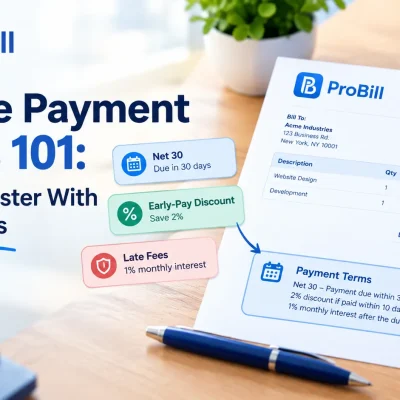
Combine these three rules in one paragraph to prevent loopholes: “Payment is due by 5 p.m. EST on 30 June 2024. Overdue balances accrue 2% interest per month, compounded daily. A 2% discount applies to invoices paid within 7 days of issue.” Embedding the clause every time you issue a bill via Create Invoice keeps wording consistent and makes the terms & conditions in invoice legally defensible.
Delivery, Ownership, and Liability Limitations Explained
Clarify who bears risk and for how long—especially vital for digital goods and cross-border shipping. Your clause should cover:
1. Transfer point: Define whether ownership passes on dispatch, delivery, or full payment.
2. Proof of delivery: Reference tracking numbers or signed receipts to cut debate short.
3. Warranty scope and duration: State what is covered, for how long, and any exclusions.
4. Liability cap: Limit damages to the invoice value or an agreed figure; the American Bar Association notes this is standard practice for SMEs.
5. Indemnity: Require the client to safeguard you against third-party claims arising from their misuse of the product or service.
Placing these details under the “Delivery & Liability” header in your terms and conditions for invoice not only sets expectations—it also deters opportunistic claims that can drain profits.
Step-by-Step Guide: How to Write Terms and Conditions for Invoice Templates
Choosing the Right Language: Plain English vs. Legalese
Clients pay faster when they understand the terms and conditions for invoice the first time they read them. Use this mini-checklist to pick wording that is clear yet enforceable:
1. Identify your audience. If 90 % of clients are small businesses, opt for Plain English; enterprise procurement teams may expect limited legalese.
2. Draft every clause in everyday language, then run it through a readability tool—aim for a Grade 8–10 score, the level the UK government recommends for contracts (https://www.plainenglish.co.uk).
3. Replace jargon with precise verbs: swap “heretofore shall remit” for “must pay.” This keeps the terms and conditions for invoice short and unambiguous.
4. Insert legal triggers only where courts demand them (e.g., “subject to the laws of New York”). Sparse legalese maintains authority without scaring buyers.
5. Test comprehension. Email a sample to a non-lawyer colleague; if any line needs explanation, rewrite it.
Repeat this loop until the entire set of terms and conditions for invoice templates can be read aloud in under two minutes. Because the language is clear, clients cannot claim they “didn’t understand” the terms and conditions on invoice, and disputes shrink before they start. For industry-specific phrasings that stay friendly yet compliant, browse the ready-made clauses inside our invoice resources by industry.
Formatting Tips to Keep Your Terms Visible and Enforceable
Even perfect wording fails if buried in fine print. Apply these design rules so your terms & conditions in invoice pop off the page and hold up in court:
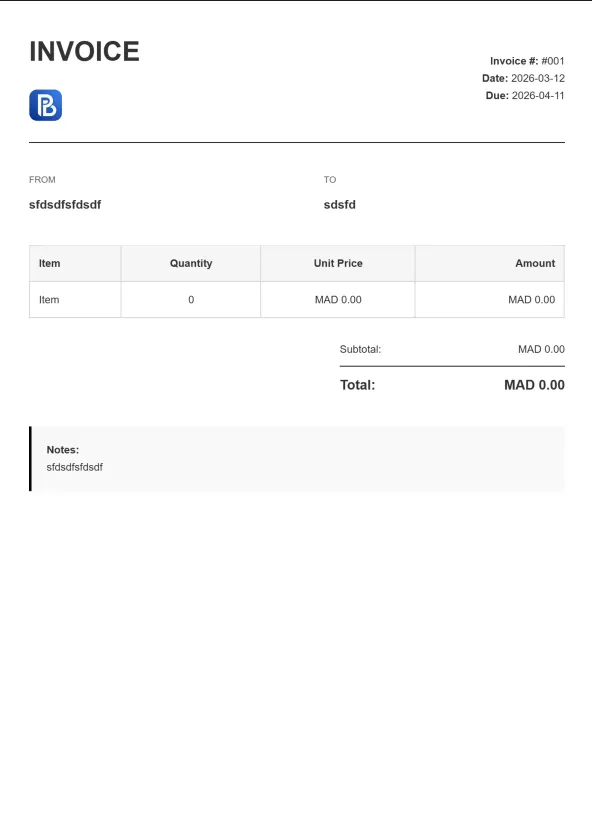
• Position: Place the complete block of terms and conditions for invoice directly beneath the line-item table—users expect to see obligations immediately after totals.
• Hierarchy: Use 11- or 12-point font; courts have struck down 8-point disclosures as “inconspicuous” (U.S. Ninth Circuit, 2019).
• Numbered sub-clauses: Enumerate each obligation (1. Payment Due Date, 2. Late Fees…) so references during disputes are laser-specific.
• Consistent templates: Lock your layout inside invoice templates or a free invoice generator to eliminate accidental omissions.
• Digital acknowledgement: Add a signature or “Pay Now” button that records a time-stamped click; the uniform format built into Create Invoice automates this.
By combining crystal-clear placement with uniform styling, you guarantee that every client sees—and consents to—the terms and conditions for invoice before work begins. Courts view such visibility as proof of assent, making the terms & conditions in invoice far easier to enforce when payments go overdue.
Compliance and Industry-Specific Considerations for Terms and Conditions on Invoice
Crafting compliant, profit-protecting terms and conditions for invoice documents gets trickier the moment you sell overseas or operate in a regulated niche. The following guidelines show how to keep your terms & conditions in invoice airtight without drowning clients in legalese.
International Clients, Currency, and Tax Regulations
Billing across borders introduces three compliance flashpoints—currency, tax, and jurisdiction. Handle each up front inside your terms and conditions on invoice to avoid costly re-issues and penalties.
Currency clarity
• State the billing currency and the FX source used to convert quotes (e.g., “Reuters 4 p.m. GMT rate”).
• Add a variance clause allowing you to re-invoice if the exchange rate swings beyond a set threshold (commonly 3 %).Tax treatment
• Identify whether you’re charging local VAT/GST, reverse-charging under EU rules, or applying U.S. sales tax nexus. Link each scenario to the customer’s tax ID to prove diligence.
• Note withholding-tax obligations for clients in India, Brazil, and Mexico; instruct them to send Form 16A or the local equivalent so you can claim treaty relief. Authoritative guidance is available from the OECD VAT guidelines (https://www.oecd.org).Jurisdiction and e-invoicing mandates
• Specify governing law plus any real-time reporting your invoice must satisfy (Italy’s SDI, India’s IRP, etc.).
• Embed mandatory XML or QR codes directly through the free invoice generator from Create Invoice to stay compliant without extra software.
Including these points in your terms & conditions in invoice files reassures global buyers and keeps your audit trail pristine.
Sector-Specific Requirements (Freelancers, E-commerce, Manufacturing)
Every industry faces its own compliance quirks, so adapt your terms and conditions for invoice rather than forcing one template on all projects.
Freelancers
• Define intellectual-property ownership and usage limits; many creatives restrict commercial use until the bill is paid in full.
• Include a kill-fee clause (25 – 50 % of project value) to cover sudden cancellations.
• Store these variants inside the invoice resources by industry library for one-click reuse.
E-commerce
• Reference consumer-protection laws (EU Distance Selling, U.S. FTC guidelines). Spell out return windows, restocking fees, and who pays return shipping.
• Add PSD2-compliant strong customer-authentication language if you’re collecting card payments directly through your checkout-linked invoices.
• List accepted gateways—PayPal, Stripe, SEPA—using dynamic fields inside customizable invoice templates.
Manufacturing
• Cite Incoterms (EXW, FOB, DDP) to clarify when risk and import duties shift.
• Detail quality-inspection procedures and acceptable tolerances; attach a certificate of conformity reference number.
• Cap consequential damages at the contract value to align with industry norms and insurer requirements.
Because these sector rules vary widely, the modular design in Create Invoice lets you toggle clauses on or off, preserving consistency while meeting every compliance hurdle. That flexibility ensures your final terms and conditions on invoice stay enforceable and crystal clear—no matter where or what you sell.
Frequently Asked Questions About Invoice Terms and Conditions
What happens if a client refuses the terms and conditions in invoice?
A refusal means no contract exists, so pause work or delivery until the client signs or you renegotiate the terms and conditions for invoice acceptance. Send an updated draft via customizable invoice templates and secure written agreement before proceeding; otherwise, courts may rule that payment is not enforceable.
Are electronic signatures legally binding on invoice terms?
Yes. Under the U.S. ESIGN Act and the EU eIDAS Regulation (https://digital-strategy.ec.europa.eu), a time-stamped digital signature carries the same weight as ink on paper, provided both parties consent to electronic records. Capturing the signature through the free invoice generator also logs IP, date, and hash, strengthening the evidentiary value of your terms & conditions in invoice files.
How often should I update my invoice terms and conditions?
Review the terms & conditions in invoice documents at least once a year or immediately after tax, consumer-protection, or currency rules change. Because wording is stored centrally in Create Invoice, a single edit updates every outgoing bill, keeping all clients on the latest version without manual rework.
Can I enforce late fees that exceed local interest caps?
No. Courts generally strike down clauses that top statutory caps, and some jurisdictions impose fines for usury. Keep late-fee wording in your terms and conditions on invoice within local limits and reference the governing law so the clause remains enforceable.
Should I include dispute resolution clauses on every invoice?
Absolutely. A one-sentence arbitration or jurisdiction clause inside the terms and conditions for invoice narrows where and how conflicts are handled, cutting legal costs and delays. Omitting it forces you to rely on default court venues, which may favor the client.
How long must I keep records of signed invoices?
Retain signed invoices and their accompanying terms and conditions on invoice for at least seven years—the period the IRS and many EU tax authorities can audit. Digital storage inside Create Invoice keeps records searchable and admissible without the clutter of paper files.
Do I need different terms for recurring invoices vs. one-off projects?
Yes. Recurring bills should spell out auto-renewal dates, variable usage fees, and cancellation notice periods, while one-off projects focus on milestone delivery and final transfer of ownership. Industry-specific samples in invoice resources by industry make it easy to tailor each set of terms & conditions in invoice documents without starting from scratch.