Skip to content


What Is an e Invoicing API & Why Your Finance Stack Needs One
An electronic invoicing API is a set of REST-based endpoints that lets your ERP or billing platform create, transmit, receive, and archive compliant invoices without human touch. Instead of logging into separate tools, developers plug the e-invoice API into existing systems—an approach often called invoice API integration. Behind the scenes, the provider handles schema conversion, digital signatures, and the e-invoicing API real-time tax authority reporting now mandated in dozens of jurisdictions. If you are wondering how does e-invoicing API work, think of it as a specialized payment rail: data flows straight from your order system to government portals and customers in milliseconds, with every regulatory field pre-validated.
SMBs that began with products like the Probill Invoice maker app, free invoice generator, or downloadable invoice templates eventually outgrow manual exports. A scalable, multi-country e-invoicing API bridges that gap by automating compliance across markets while preserving the familiar front-end they already use for invoice creation in NetSuite or other ERPs.
Electronic invoicing API vs. traditional invoicing software: a side-by-side look
| Feature | Traditional invoicing software | E-invoicing API integration |
|---|---|---|
| Deployment | Desktop or cloud UI a user must log into | Lightweight REST calls embedded in your finance stack |
| Data entry | Manual fields or CSV uploads | Automated data hand-off from ERP, CRM, or checkout flow |
| Compliance updates | Requires software patch or user action | Provider pushes schema and rule changes instantly |
| Real-time reporting | Often limited, batch exports at month-end | Built-in real-time tax authority reporting per country |
| Scalability | Licenses per user; performance tied to UI | Any volume; horizontal scaling via microservices |
| Use cases | Small teams issuing a few invoices a day | High-volume SaaS, marketplaces, global retailers |
| Example tools | Stand-alone invoicers, Create Invoice | API providers, internal microservices |
Traditional apps still serve freelancers well, but enterprises seeking automated e-invoicing across borders need the API model’s flexibility.
Core benefits: speed, accuracy, and global tax compliance on autopilot
An e-invoice API brings three game-changing advantages to your finance stack:
Speed: API calls generate legally signed invoices in milliseconds, shrinking order-to-cash cycles compared with GUI-driven tools. Faster billing accelerates collections and improves cash flow.
Accuracy: Schema validation and business-rule engines cut data-entry mistakes that plague human workflows. This ties directly into stronger invoice processing systems and reduces costly credit notes.
Compliance at scale: Whether you operate in Italy, Mexico, or India, the multi-country e-invoicing API automatically adapts XML or JSON payloads, attaches mandated QR codes, and submits them to tax portals—no local expertise required. This “autopilot” approach reinforces enterprise-grade invoice management solutions and future-proofs your stack against upcoming mandates.
Coupled with a modern cloud invoicing infrastructure and automated invoice workflows, an API-first strategy lets finance teams focus on analytics rather than upkeep. For a primer on the concepts behind compliance formats and regional differences, see what electronic invoicing means and explore our curated invoice resources by industry.
How Does an e-Invoicing API Work? From Invoice Creation to Real-Time Tax Authority Reporting
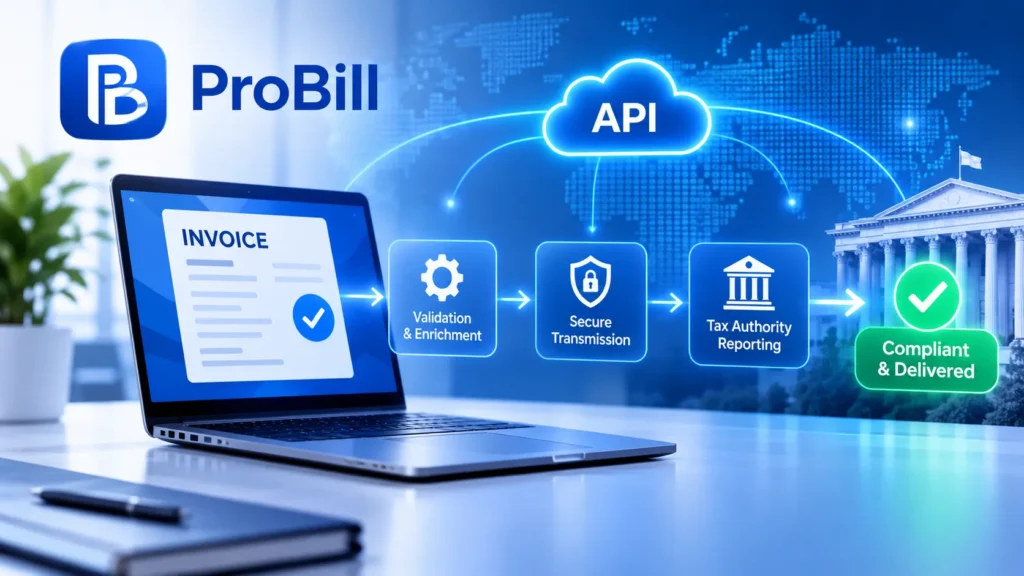
Inside the data flow: how an e invoice API validates, transforms, and transmits your documents
An electronic invoicing API sits between your billing source and every external recipient. Invoices may originate in an ERP, a checkout flow, or front-end tools such as Create Invoice, the Probill Invoice maker app, or any free invoice generator. Regardless of origin, the invoice API integration funnels data through the same automated pipeline:
Capture
Raw header and line-item data is pulled via REST from your ERP (for example, invoice creation in NetSuite) or pushed from a UI that relies on predefined invoice templates.Canonical mapping
The e-invoice API converts disparate formats into a unified internal schema, eliminating the brittle field mapping that plagues ad-hoc e-invoicing integration projects.Business-rule validation
Hundreds of jurisdictional checks—tax rates, currency rules, mandatory IDs—run through the provider’s engine. Failures are surfaced instantly to upstream invoice processing systems for correction.Compliance enrichment
The API adds digital signatures, QR codes, or hash chains as required. This step turns a simple invoice into a legally accepted document ready for cross-border use in a multi-country e-invoicing API scenario.Format transformation
Data is serialized into each recipient’s mandated format (UBL XML, CFDI JSON, Factur-X PDF, etc.) without developer rework.Secure transmission
Documents are dispatched via HTTPS, AS4, or PEPPOL to customers and government nodes. Status changes trigger webhooks that feed your invoice management solutions and dashboards.Archiving
Signed originals and acknowledgments are stored in tamper-proof vaults, completing the end-to-end automated e-invoicing loop.
Real-time tax authority reporting: ensuring every invoice meets live compliance checkpoints
Most mandates now require e-invoicing API real-time tax authority reporting, meaning the invoice must be cleared by a government platform before it reaches the buyer. A robust e-invoice API handles this synchronously so cash-collection cycles stay fluid, even when shipping to multiple countries.
Typical live checkpoints include:
- Structural validation against the latest XSD published by each tax authority.
- Duplicate and sequence controls to prevent missing or reused invoice numbers.
- Calculation cross-checks for VAT, GST, or withholding taxes, with industry-specific deltas referenced in our invoice resources by industry.
- Digital signature verification and issuance of unique approval codes (e.g., IRN in India, UUID in Mexico).
- Automated return of acceptance or rejection messages, which trigger downstream automated invoice workflows in your finance stack.
Because the same API endpoint can talk to Italy’s SDI today and France’s PDP network tomorrow, enterprises gain a single, future-proof interface. Horizontal scaling on a cloud invoicing infrastructure absorbs end-of-month spikes, while real-time webhooks keep stakeholders informed within seconds—answering the perennial question “how does e-invoicing API work?” in one seamless, compliant heartbeat.
Scaling Globally: Multi-Country e-Invoicing API Compliance Made Simple

Navigating regional e-invoice mandates: VAT, Peppol, CTC models, and more
Moving from domestic tools like Create Invoice, the Probill Invoice maker app, or quick-fix invoice templates to a multi-country e-invoicing API means mastering very different legal frameworks. Europe’s VAT clearance, Singapore’s Peppol network, and Latin America’s clearance (CTC) regimes each dictate how invoices are formatted, signed, and reported. Without a unified invoice API integration, finance teams end up maintaining parallel workflows that don’t scale past a handful of jurisdictions.
| Mandate model | Typical regions | Compliance flow | Key API tasks |
|---|---|---|---|
| VAT post-audit | Germany, UK | Buyer stores invoice; audits occur later | Provide UBL/Factur-X, archive copies, support invoice processing systems |
| Peppol (four-corner) | Singapore, Belgium, Australia | Documents routed through certified access points | Map to BIS 3.0, handle AS4/HTTPS, manage Peppol IDs |
| CTC real-time clearance | Italy (SDI), Mexico (CFDI), India (IRP) | Invoice must be pre-approved by tax portal before delivery | Perform digital signatures, push to authority, receive UUID/IRN, enable e-invoicing API real-time tax authority reporting |
A robust electronic invoicing API abstracts these differences. Developers send one canonical payload; under the hood the provider handles signatures for CTC, AS4 tunnelling for Peppol, or periodic SAF-T exports for VAT. That simplification is why enterprises ask, “how does e-invoicing API work across so many rules?”—the answer lies in dynamic schema mapping and jurisdiction-aware validation baked into the service.
Built-in localisation: automated updates when regulations change overnight
Mandates evolve quickly—Italy altered XML schemas three times last year, and France’s upcoming PDP model adds fresh web-service endpoints. With built-in localisation, a modern e-invoice API updates rule sets centrally and propagates them across every connected ERP, from SAP to invoice creation in NetSuite, without code rewrites. Webhooks trigger your automated invoice workflows so finance doesn’t miss a beat.
Because the provider runs on elastic cloud invoicing infrastructure, new certificates, XSDs, and QR-code specs deploy globally within minutes. Country-specific defaults—tax IDs, currency symbols, language strings—are injected automatically, keeping output consistent with local business etiquette and reducing help-desk tickets by off-shore teams. Compliance evidence then feeds back into your invoice management solutions and industry-specific dashboards sourced from our invoice resources by industry.
For companies graduating from a free invoice generator to automated e-invoicing at scale, this localisation layer is the difference between costly fire drills and silent, overnight compliance. In effect, e-invoicing integration turns regulatory change into a background service—one more micro-update rolled into your global release pipeline.
Seamless Invoice API Integration: Embedding Automated e-Invoicing Into Your Existing Systems
Plug-and-play patterns for ERP, CRM, and custom app ecosystems
Adopting an electronic invoicing API rarely requires a rip-and-replace project. Instead, you wrap the e-invoice API around the data sources you already trust—whether that is SAP, Dynamics, or a storefront powered by the Create Invoice front-end. Because the provider exposes RESTful endpoints, developers can embed calls directly into scheduled jobs, webhooks, or serverless functions without disrupting frontline users.
| System type | Typical touchpoint | Recommended invoice API integration pattern | Trigger for API call |
|---|---|---|---|
| ERP (e.g., invoice creation in NetSuite) | Sales or billing module | Outbound middleware connector that formats canonical payload | “Invoice posted” event |
| CRM (Salesforce, HubSpot) | Opportunity-to-cash workflow | Managed package or Apex/SDK extension calling the e invoice API | Opportunity marked “Closed Won” |
| Marketplace / e-commerce | Checkout microservice | Event-driven Lambda or Cloud Function | Payment authorization success |
| Legacy desktop apps such as Probill Invoice maker app | CSV export folder | Lightweight daemon that polls and transforms files into API payloads | New file detected |
| Low-code tools & free invoice generator prototypes | REST action block | No-code HTTP module referencing API key vault | Button click or schedule |
Because each pattern preserves the incumbent UI, finance teams can keep familiar invoice templates while upgrading the back end to automated e-invoicing. The same approach scales to multi-tenant SaaS platforms: a wrapper microservice watches message queues, enriches data for e-invoicing API real-time tax authority reporting, and posts acknowledgments back to downstream invoice processing systems in seconds. If you ever wonder how does e-invoicing API work inside a diverse stack, remember that the API only needs a well-defined trigger and a secure payload to deliver compliance everywhere.
Performance, security, and uptime: best practices for automated e-invoicing at scale
High-volume billing cycles demand more than simple REST calls. Follow these practices to keep your multi-country e-invoicing API resilient and secure:
Event buffering and retries
Queue invoices in a durable message bus (Kafka, SQS) to absorb spikes and automate retries for transient HTTP 5xx responses—crucial when tax portals throttle e-invoicing integration traffic.Idempotent request design
Use deterministic invoice IDs so replays caused by network hiccups do not create duplicates in your invoice management solutions.Real-time observability
Stream structured logs and webhook statuses into APM tools; flag any delay longer than the SLA for e-invoicing API real-time tax authority reporting so collections aren’t delayed.Secrets management and encryption
Store API keys in vault services, rotate certificates regularly, and enforce TLS 1.3 to secure sensitive line-item data as it moves between systems.Geo-redundant deployment
Host the integration layer on elastic cloud invoicing infrastructure across multiple regions to guarantee 99.9%+ uptime even during maintenance windows.Automated fallback workflows
When an authority gateway is offline, route invoices through contingency endpoints and surface tasks to finance via automated invoice workflows, preventing revenue leakage.
By weaving these safeguards into your pipeline, you transform the e-invoice API from a helpful add-on into a mission-critical backbone that silently powers global billing and compliance.
Choosing the Right e-Invoicing Integration Partner
Must-have features, SLAs, and support levels to demand from your provider
A first-rate electronic invoicing API partner must handle present mandates and anticipate future ones. Insist on these core features:
- Multi-jurisdiction engine that automatically adapts payloads for every clearance, Peppol, or post-audit regime, giving you a single multi-country e-invoicing API endpoint.
- Built-in e-invoicing API real-time tax authority reporting with synchronous status webhooks so your finance team never wonders how does e-invoicing API work behind the scenes.
- Dynamic schema updates pushed through containerised cloud invoicing infrastructure—no downtime or code rework when Italy, France, or India change formats overnight.
- Native connectors for common ERPs, plus clear REST documentation to speed invoice API integration into custom stacks and invoice processing systems.
- Secure vaulting and tamper-proof archiving that feed downstream invoice management solutions.
SLA language should be as rigorous as the tax rules you are outsourcing. Look for:
- 99.9 %+ platform uptime and <200 ms median API response time.
- Guaranteed clearance submission within one minute for each jurisdiction and automated fallback queues when authorities are offline.
- 24×7 incident response with tiered escalation; live chat plus phone support during peak billing windows.
Finally, evaluate support depth. Providers serious about e-invoicing integration assign a named compliance advisor who monitors mandate roadmaps and pushes configuration updates before they become urgent. Documentation should cover edge cases—credit notes, self-billing, or the Probill Invoice maker app CSV exports—so your dev team spends minutes, not days, decoding exceptions.
ROI snapshot: calculating cost savings and time-to-compliance gains
Quantifying the payback of an e-invoice API is straightforward once you isolate the right levers.
- Establish your manual baseline: average cost per invoice (labor, printing, postage, error correction) and days from issue to cash.
- Add projected compliance costs for each new jurisdiction—development hours, audits, and one-off local consultancy fees.
- Input provider fees and a modest implementation estimate (often <80 dev hours thanks to reusable invoice templates and SDKs).
- Model savings from automated error prevention, faster clearance, and the elimination of parallel systems such as a standalone free invoice generator.
| Metric | Legacy process | With e-Invoicing API | 12-month delta |
|---|---|---|---|
| Direct cost per invoice | $6.15 (manual entry + mail) | $1.80 (API calls + storage) | –70 % |
| Average DSO | 42 days | 32 days | –10 days |
| New-country rollout time | 4–6 months | 4–6 weeks | –75 % |
| Internal compliance effort | 240 hrs/year | 40 hrs/year | –83 % |
Because the e invoice API automates validation, signing, and reporting, your finance stack moves invoices through order-to-cash faster, and your team redeploys those reclaimed hours into analytics and automated invoice workflows. Most companies break even within two billing cycles—proof that a well-chosen partner turns automated e-invoicing from a regulatory burden into a net profit driver.
Frequently Asked Questions About e-Invoicing APIs
Is e-invoicing mandatory in my country?
Mandates vary widely: Mexico and Italy already require electronic clearance for most businesses, while the U.S. still relies on post-audit models. To check the latest status—and sector-specific exemptions—review government notices alongside the contextual guides in our invoice resources by industry and the primer on what electronic invoicing means. Even freelancers issuing bills through the Probill Invoice maker app may need to switch to an e-invoice API once their turnover or customer profile triggers local thresholds.
How long does e-invoice API implementation typically take?
Most teams embed the e-invoice API in 2–6 weeks, depending on ERP complexity and test volume. Lightweight setups that export data from tools like Create Invoice or trigger events after invoice creation in NetSuite often go live within a single sprint because the provider supplies SDKs, webhooks, and sandbox environments out of the box.
Can the API validate digital signatures, QR codes, and other local requirements?
Yes. A mature multi-country e-invoicing API includes rule engines that apply country-specific signatures, cryptographic seals, or QR codes before dispatching documents to tax portals. Validation results feed back into your invoice processing systems so errors are surfaced instantly rather than during audits.
What formats (XML, JSON, PDF) does the electronic invoicing API support?
The service converts one canonical payload into every mandated format—UBL XML for Europe, CFDI JSON for Mexico, or hybrid PDF/A-3 for France’s Factur-X. It also handles customer-friendly renderings, so invoices that began as invoice templates or a quick draft in a free invoice generator emerge fully compliant without extra coding.
How does pricing work for high-volume invoice traffic?
Providers usually combine a base platform fee with tiered per-invoice rates that fall sharply once you exceed set thresholds. Because the engine runs on elastic cloud invoicing infrastructure, volume spikes are absorbed automatically, and you pay only for successful API calls—not retries generated by downstream tax portals.
What happens if tax rules change overnight?
Schema and rule updates are pushed centrally—often hours after authorities publish new specs—so your integration keeps passing e-invoicing API real-time tax authority reporting checks without code changes. Release notes and webhook alerts can kick off automated invoice workflows that update master data or notify finance teams, preventing invoice rejections the next morning.
How secure is the data transferred through the API?
Traffic is encrypted end-to-end via TLS 1.3, keys are stored in hardware security modules, and payloads are signed to ensure non-repudiation. Access controls, audit trails, and tamper-proof archiving integrate seamlessly with enterprise invoice management solutions, giving you visibility and compliance proof without compromising performance.