Skip to content

Invoice vs Receipt: A 2-Minute Definition Snapshot
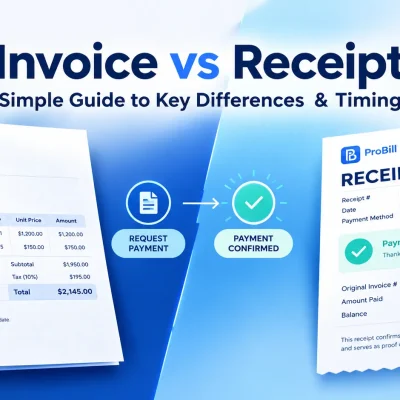
Still wondering, “is an invoice the same as a receipt”? The short answer is no. The two documents serve opposite points in the payment timeline, and understanding invoice vs recipt distinctions keeps your books clean and your customers clear on next steps. This snapshot breaks down exactly what’s the difference between a receipt and an invoice—in two bite-size lists you can scan in under 120 seconds .
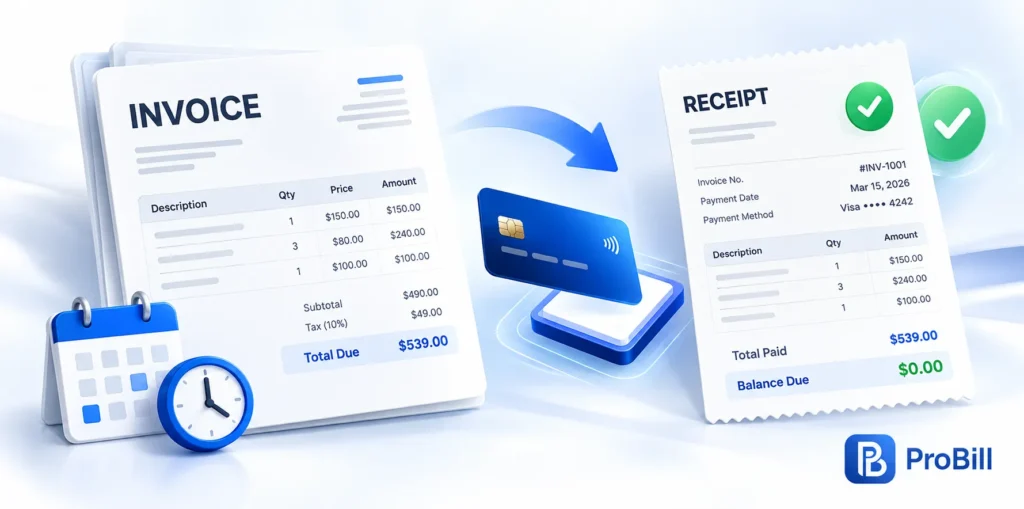
What an Invoice Includes (Before Payment)
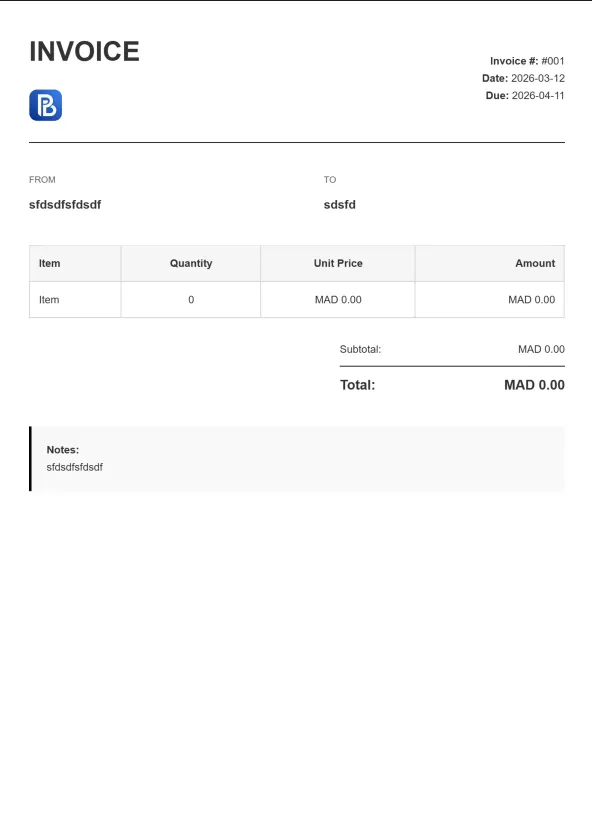
An invoice is a request for money that goes out before cash comes in. Here’s the essential data it must show:
- Supplier details—legal name, address, tax ID, and any licensing info.
- Buyer information that matches the contract or purchase order.
- Unique invoice number plus issue date for seamless tracking and paid invoice status updates.
- Itemized description of goods or services, quantities, unit prices, and line-item taxes.
- Due date, accepted payment methods, and late-fee policy to answer “is invoice and receipt the same” questions up-front.
- Subtotal, taxes, discounts, and the grand total the customer must pay.
Need a fast, error-free format? Choose from ready-made invoice templates or use our free invoice generator to send professional invoices and receipts in minutes. For niche billing—construction, photography, consulting—browse tailored invoice resources by industry.
What a Receipt Confirms (After Payment)
Think of the receipt as the mirror image that appears once payment hits your account. It confirms completion and helps anyone asking “is invoice the same as receipt” see the lifecycle’s end:
• Proof of payment: amount received, date, and method (card, ACH, cash).
• Reference to the original invoice number for effortless reconciliation of invoices and receipts.
• Updated balance (usually $0.00) confirming no money is owed, quelling “what is the difference between invoice and receipt” confusion.
• Seller and buyer details repeated for audit trails and tax records.
• Signature, stamp, or automated confirmation code that legally finalizes the sale.
Accountants often call this the “receipt for invoice,” a phrase that answers “what’s the difference between an invoice and a receipt” because it literally links both documents. If you also juggle statements or bills, see our comparisons on invoice vs bill and invoice vs statement. Ready to issue your next document? Head over to Create Invoice and turn this definition into action.
Wondering what is the difference between a receipt and an invoice in regulatory terms? The U.S. Small Business Administration clarifies that invoices demand payment while receipts acknowledge it (source: sba.gov). That’s the nutshell answer to “what’s the difference between invoice and receipt” and the final word on invoice vs recipt essentials.
Key Differences That Matter: When, Why, and Who Issues Each Document
Timing: The Critical Moment That Separates an Invoice and a Receipt
The easiest way to answer “is an invoice the same as a receipt?” is to zoom in on timing.
1. An invoice is drafted the instant the seller is ready to demand payment—usually right after goods ship or a service milestone is hit. It’s the seller’s formal “pay me” notice, not proof that money moved.
2. A receipt, by contrast, is born only after cash, card, ACH, or crypto lands in the bank. It’s the buyer’s evidence that the bill is closed.

Why the split second matters: regulators treat unpaid and paid documents differently. Until settlement, the seller controls the transaction and must chase collection; afterward, the burden shifts to record-keeping. This temporal hand-off clarifies “is invoice and receipt the same” doubts and prevents duplicate revenue recognition.
Who presses “send” also changes. Sales or project managers typically issue invoices from tools like the free invoice generator, while accounting software may auto-email the receipt for invoice once payment clears. That workflow—request first, confirm later—answers what is the difference between a receipt and an invoice in everyday operations.
Need special timing rules for your field? See our invoice resources by industry for sector-specific cut-off points.
Required Information on Each Document to Stay Tax-Compliant
Understanding what’s the difference between invoice and receipt isn’t just academic; missing data can trigger fines. U.S. IRS Publication 463 and the EU VAT Directive both insist that each document shows distinct identifiers:
• Invoices must display a tax ID and sequential number so authorities can trace outstanding liabilities.
• Receipts must record the exact amount received, method, and a clear $0.00 balance to lock in revenue timing for audit trails.
Both documents also need matching seller-buyer details, but only invoices require payment terms, and only receipts need a transaction authorization code. This divergence solves “is invoice the same as receipt” compliance puzzles.
Digital or paper, you must archive invoices and receipts for at least three years in the U.S. and up to ten in many EU states (source: IRS & EU Commission). Automating storage in Create Invoice helps you meet those retention clocks without clutter.
Finally, if you’re juggling related forms—statement of account, bill, or paid invoice note—review our comparisons on invoice vs bill, invoice vs statement, and our guide to a paid invoice. With these checkpoints, what is the difference between invoice and receipt—and the broader invoice vs recipt debate—should never trip up your books or your tax inspector.
The Real-World Impact of Mixing Up Invoices and Receipts
Every week our support desk fields frantic emails that begin, “is an invoice the same as a receipt?” The false belief that invoices and receipts are interchangeable still trips up otherwise savvy founders. When a busy owner uploads the wrong file to accounting software, that single click can inflate revenue, delay collections, and even flag a tax audit.
Below we unpack exactly what happens when you blur the line between the two documents—because understanding what is the difference between invoice and receipt is the fastest way to protect cash flow and compliance. For a refresher on the data points each form should show, see what an invoice is.
Accounting & Cash-Flow Errors That Hurt Small Businesses
Small firms live or die by liquidity. Accidentally labeling receipts as unpaid bills—or vice-versa—creates a domino effect:
• Duplicate revenue recognition: Marking a receipt for invoice as an outstanding bill forces your system to log the same sale twice, skewing P&L reports and masking real margins.
• Artificially aged receivables: The opposite error, saving an invoice as a receipt, wipes it from A/R ledgers. No one chases payment, and you wonder why the bank balance lags behind projections.
• Lost deductions & mismatched taxes: Sales tax engines rely on “paid” status to book liabilities. Confusion means you may pay tax before money arrives or miss write-offs for expenses, a costly flaw highlighted in paid invoice guides.
Quick fixes exist. Use invoice templates that label each document clearly, or automate with the free invoice generator to push “invoice,” “paid,” or “receipt” tags directly into QuickBooks. Build cross-checks in your chart of accounts: unpaid sales live under A/R, settled sales feed the revenue line. If you also juggle bills or statements, compare your workflow to our invoice vs bill and invoice vs statement explainers so “is invoice and receipt the same” never sabotages reporting.
Legal and Audit Risks of Mislabeling Financial Documents
- VAT & sales-tax penalties: EU tax authorities fine up to €2,000 per incorrect document because the date on a receipt locks in the tax point, while an invoice merely schedules payment. Mixing the two invites immediate scrutiny.
- Contract enforcement gaps: Courts need a clear audit trail. Presenting a mislabeled “invoice” as proof of settlement can void late-fee claims or interest charges when customers dispute balances—another reason to check “what’s the difference between a receipt and an invoice” before litigation.
- Audit red flags: According to the U.S. IRS, inconsistent source documents are a top-10 cause of extended field audits. A batch of files tagged “invoice vs recipt” in cloud storage suggests sloppy controls, triggering deeper digs that stall funding rounds.
Sector-specific rules compound the risk. Construction firms, for example, must issue progress invoices that differ from final receipts; missteps delay lien releases. Consult the invoice resources by industry center for nuances in your field.
Finally, embed document workflows directly in Create Invoice so every file carries immutable metadata. When an auditor asks, “is invoice the same as receipt?” you can instantly demonstrate what is the difference between a receipt and an invoice, preserving both your reputation and your balance sheet.
Automating Invoices and Receipts: Tools & Tips to Save Hours Every Month
Setting Up a Workflow: From Invoice Creation to Receipt Delivery
Automating invoices and receipts starts with a clear, repeatable path that shuts down the “is an invoice the same as a receipt, is invoice and receipt the same, or is invoice the same as receipt” confusion before it begins. Follow this five-step flow and watch the manual busywork vanish.
- Pick your format. Load industry-specific invoice templates or the free invoice generator so every new file has pre-filled seller details, tax IDs, and sequential numbers.
- Draft the bill. A smart editor pulls product data from your CRM and links to our primer on what an invoice is for instant team reference.
- Schedule dispatch. Set rules—send immediately, on shipment, or at project milestone—so the request lands exactly when cash is expected. This built-in timing echoes the guidance in invoice vs bill and prevents overlap with statements outlined in invoice vs statement.
- Collect payment automatically. Stripe, ACH, or PayPal integrations flag settlement in real time and trigger a status change to paid invoice—no spreadsheets or sticky notes.
- Auto-issue the receipt. The system references the original number, stamps a $0.00 balance, and emails the legally compliant receipt for invoice within seconds. Users who once asked “what is the difference between a receipt and an invoice” now get proof without lifting a finger.
Need niche rules—progress billing, retainers, or stage payments? Browse the invoice resources by industry library to slot field-specific logic into the same workflow. With these guardrails, automating invoices and receipts eliminates duplicate data entry and all but ends filename typos like “invoice vs recipt.”
How Our Software Eliminates Manual Data Entry (Free 14-Day Trial)
Create flawless documents while our engine handles the grunt work. Automating invoices and receipts inside Create Invoice delivers:
• OCR + AI line-item capture. Upload vendor bills and the platform matches items to catalog codes—instantly clarifying what is the difference between invoice and receipt in your audit trail.
• One-click reconciliation. Payments hitting the bank auto-match to open invoices, marking them as paid and firing the receipt without staff intervention. That instant update answers what’s the difference between a receipt and an invoice for anyone peeking at the dashboard.
• Dynamic FAQs. Hover-tips pop up with answers to “what’s the difference between an invoice and a receipt,” “what’s the difference between invoice and receipt,” and related queries, so new hires never have to Google again.
• Error shields. Validation rules spot mismatched dates, duplicate numbers, and missing tax IDs—ensuring no user ever wonders again if automating invoices and receipts can cause slips.
• Compliance archive. Every document, from first draft to final receipt, is sealed in tamper-proof storage with search tags for invoices and receipts; auditors retrieve files in seconds.
Sign up for the free 14-day trial and see how automating invoices and receipts shaves hours off month-end close. The onboarding wizard even calls out “is an invoice the same as a receipt,” “what’s the difference between invoice and receipt,” and other FAQs so users grasp distinctions from day one—no more late-night searches for is invoice the same as receipt.
Frequently Asked Questions About Invoices and Receipts
Is an invoice the same as a receipt?
No—“is an invoice the same as a receipt” is a common question, but the two serve opposite ends of the payment timeline. An invoice requests money before settlement, while a receipt confirms funds arrived. For a deeper dive, see our explainer on what an invoice is.
What’s the difference between a receipt and an invoice for tax records?
Tax agencies treat the documents differently: invoices create accounts-receivable, whereas receipts lock in revenue or deductible expense. Because the rules can vary by sector, check the invoice resources by industry hub and the comparison in invoice vs bill to avoid misfiling. In short, what is the difference between a receipt and an invoice? Timing and proof.
Can I use an invoice as proof of payment?
Generally no. Auditors want a “receipt for invoice” or a stamped paid invoice as evidence that cash actually moved. Until that status updates (use the paid invoice guide), the question “is invoice and receipt the same” will trigger a rejection of your claim.
When should I send a receipt for invoice payments?
Issue the receipt immediately after funds clear—your accounting software or our free invoice generator can automate this. Prompt delivery gives buyers real-time proof and stops them asking “is invoice the same as receipt” when trying to reconcile balances in their own ledgers.
Do digital invoices and receipts hold the same legal weight?
Yes. Under the U.S. ESIGN Act and the EU eIDAS Regulation, properly stored electronic files carry equal enforceability to paper (source: FTC.gov). Just archive them with immutable metadata and reference numbers, then cross-check totals with invoice vs statement reports; what is the difference between invoice and receipt remains the same whether analog or digital.
What happens if I lose a receipt but still have the invoice?
First, flag the transaction as “invoice vs recipt mismatch” in your system. Then regenerate a receipt using pre-approved invoice templates and payment confirmation from your bank or processor. This replacement satisfies “what’s the difference between a receipt and an invoice” requirements because it documents final payment while keeping the original invoice intact.
How do I correct mistakes on invoices and receipts?
Issue a credit note or revised document—never alter the original—so auditors can trace changes and confirm is invoice the same as receipt status remains clear. Tools inside Create Invoice let you void, edit, and resend files in minutes, ensuring “what’s the difference between an invoice and a receipt” is always transparent across all invoices and receipts.