Skip to content

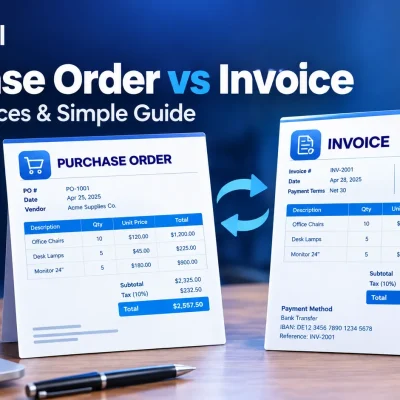
Purchase Order vs Invoice: A 60-Second Snapshot
Why Businesses Need Both Documents in the Procure-to-Pay Cycle
A purchase order and invoice form the backbone of spend control and revenue recognition. While a PO legally locks in price, quantity, and delivery terms, the matching invoice triggers payment and revenue recording—two very different compliance checkpoints that protect cash on both sides of the transaction. Because the purchase order and invoice each address a separate risk (unapproved spend vs. unpaid sale), finance teams that skip either step invite disputes, delivery delays, and audit flags.
Key roles each document plays:
• PO: budget approval, encumbrance, vendor authorization
• Invoice: accounts payable coding, tax calculation, receivable for the seller
Using both also streamlines downstream processes that your AP team automates with tools like a free invoice generator or standardized invoice templates. For SMBs scaling fast, integrating a purchase order and invoice workflow cuts manual follow-ups by up to 50% according to AP benchmarks cited by Investopedia. That efficiency pays dividends when paired with task-specific resources such as our invoice resources by industry. Ultimately, the purchase order and invoice tandem eliminates ambiguity, which is the core difference between purchase order and invoice functions.
Where a Purchase Order and Invoice Fit From Request to Payment
Follow this simplified timeline to see exactly where a purchase order and invoice appear, and how the documents interact at every control gate:
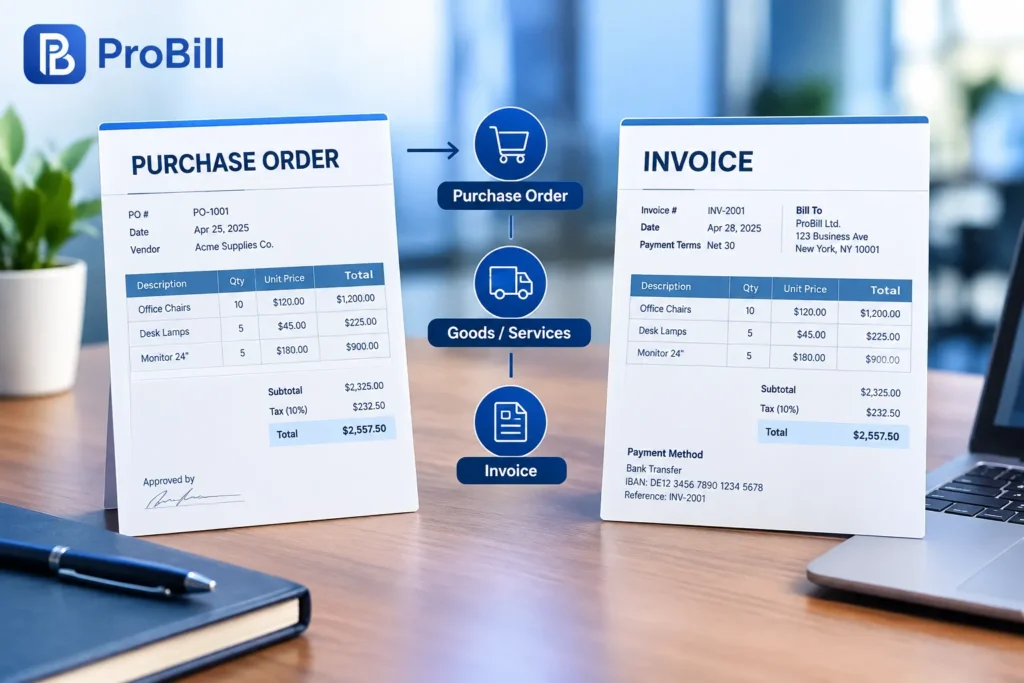
- Requisition submitted → finance reviews budget.
- PO issued to vendor → goods/services shipped.
- Delivery verified → vendor submits invoice that references the PO.
- Three-way match (PO, goods receipt, invoice) passes → payment scheduled.
- Remittance sent → books closed with matched documentation.
Along that timeline, note the subtle yet critical difference between invoice and purchase order: the former requests money while the latter authorizes spend. Understanding that difference between a purchase order and an invoice safeguards working capital and audit readiness. If you still wonder what is the difference between purchase order and invoice, compare the PO’s commitment to the seller’s claim for cash—this contrast is also the difference between PO and invoice in ERP systems.
Need deeper context on billing docs beyond the PO flow? Explore what an invoice is, how it contrasts with an invoice vs bill, or the nuances in an invoice vs receipt. Together, those guides clarify what is purchase order invoice processing and the difference between purchase order and purchase invoice, rounding out your end-to-end payables knowledge—especially handy when you next Create Invoice in seconds or browse types of invoices for specific use cases.
Key Differences Between a Purchase Order and an Invoice
Side-by-Side Comparison Table: Difference Between PO and Invoice
| Attribute | Purchase Order (PO) | Invoice |
|---|---|---|
| Core purpose | Locks in price, quantity, and delivery terms before fulfillment | Requests payment after goods/services are delivered |
| Issued by | Buyer’s procurement or finance team | Seller’s accounts receivable team |
| Timing in workflow | Generated after internal approval but before shipment | Sent once delivery is confirmed or milestones met |
| Legal status | Becomes a binding offer when accepted; can be cited in court to enforce agreed terms (ICC Incoterms) | Serves as a commercial claim for money owed; required for tax compliance in many jurisdictions |
| Accounting impact | Creates a budget encumbrance and helps prevent unapproved spend | Creates an accounts payable for buyer and accounts receivable for seller |
| Matching control | Compared to receiving report and invoice in a three-way match | Must reference the PO number to pass the same three-way match |
| Key data fields | PO number, item description, unit cost, delivery schedule, buyer signature | Invoice number, PO reference, tax ID, payment terms, remittance details |
| Common automation tools | ERP requisition modules, procurement portals | AP software, a free invoice generator, standard invoice templates |
| Typical retention period | Until warranty or contract period ends | Until statutory audit window closes (often 7 years) |
The table highlights the primary difference between purchase order and invoice mechanics: one authorizes spend, the other demands payment. Understanding this difference between PO and invoice documents keeps your procure-to-pay cycle audit-ready.
How Each Document Protects Buyer and Seller (Legal & Financial Impacts)
Failing to grasp the difference between a purchase order and an invoice can erode profit margins fast. Here’s how each file shields the parties involved:
Buyer safeguards
• Budget enforcement: A PO caps the maximum liability before a cent leaves the bank.
• Contractual clarity: If a shipment arrives short, the buyer can point to the PO’s agreed quantity to deny excess invoicing.
• Fraud defense: Three-way matching isolates bogus supplier invoices—an area where the Association of Certified Fraud Examiners notes 22 % of fraud cases originate.Seller protections
• Guaranteed receivable: Once a PO is accepted, the seller can produce confidently, knowing payment is contractually supported.
• Faster cash collection: A precise invoice that mirrors the PO reduces disputes and days sales outstanding, a KPI tracked by Deloitte.
• Tax compliance: Accurate invoicing is mandatory for VAT or sales-tax filings; mismatches trigger fines.Mutual legal enforceability
• Courts often view the purchase order and invoice together as the full contract. The buyer’s signature on the PO plus the seller’s signed invoice forms a paper trail that meets International Accounting Standards.
• Electronic records: Digital POs and e-invoices hold equal weight under the U.S. E-SIGN Act, provided both sides consent.Working-capital optimization
• Buyers schedule payments strategically after a valid invoice, maintaining cash on hand.
• Sellers can factor invoices as collateral for short-term financing—impossible without the underlying PO to validate the receivable.
Because the difference between invoice and purchase order responsibilities is so pronounced, finance teams often integrate them inside a single dashboard. When you Create Invoice from within your ERP, the PO data auto-populates fields, eliminating keystroke errors. That integration answers the perennial question, “what is the difference between purchase order and invoice?” by letting users trace every dollar from requisition to receipt.
Still puzzling over what is purchase order invoice documentation versus a bill or receipt? Compare the formats in our guides on invoice vs bill, invoice vs receipt, and the many types of invoices deployed across industries. Each article illustrates another subtle difference between purchase order and purchase invoice records, reinforcing the critical difference between purchase order and invoice controls in modern accounting.
Creating & Managing POs and Invoices: Best-Practice Workflow
Automated Tools for Generating Accurate Purchase Orders
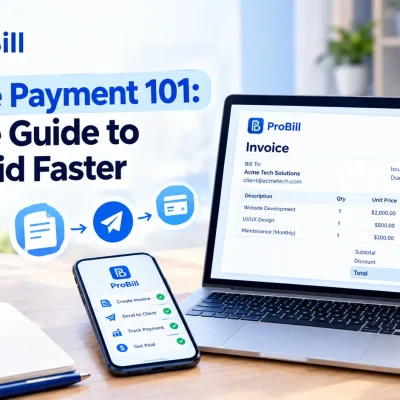
Relying on email threads or shared spreadsheets almost guarantees that a purchase order and invoice will disagree later. Modern procurement suites—many of which plug into a free invoice generator or ERP—eliminate those mismatches by pulling contract, catalog, and budget data into one screen.
Key automations you should activate:
1. Dynamic vendor catalogs auto-fill SKU, price, and tax codes, so the purchase order and invoice reference identical master data.
2. Real-time budget encumbrance warns requesters if they exceed funding before the PO even routes for approval.
3. E-sign and timestamp capture turn the PO into a legally binding document the moment the supplier accepts it.
Follow this 4-step workflow to issue a rock-solid PO in under five minutes:
1. Select vendor and items from the catalog.
2. System validates GL coding and budget.
3. Approver signs digitally; PO number is generated.
4. Supplier receives the electronic PO in their portal or via EDI.
Because the tool reuses the same data later, the difference between purchase order and invoice amounts is usually zero—saving hours of rework. For industries with specialized line-item requirements, preload role-specific invoice templates so every subsequent invoice references the correct PO fields. Need niche compliance rules? Our curated invoice resources by industry plug straight into the same workflow.
Whenever you eventually Create Invoice from the supplier side, the system back-fills PO data automatically. That tight integration demonstrates what is purchase order invoice processing in practice and highlights the difference between po and invoice creation dates without manual keying.
Three-Way Matching: Linking Purchase Order, Invoice, and Receipt for Faster Approvals
Three-way matching is the control gate that keeps every purchase order and invoice honest. The AP subsystem cross-checks (1) PO quantity and price, (2) the warehouse receipt, and (3) the incoming invoice before cutting a payment. Automating this match can shrink average invoice approval time by 67%, according to the Institute of Finance & Management (IOFM).

A streamlined three-way match looks like this:
1. Receipt posted: Warehouse staff confirm quantity; system ties the receipt to the PO automatically.
2. Invoice captured: Supplier e-mails a PDF or uses EDI; OCR or API mapping extracts fields and links them to the PO number.
3. Match engine runs: If price, quantity, and tax align within tolerance, the invoice posts straight to “ready-to-pay.” Exceptions route to the stakeholder who can fix them fastest.
Embedding tolerance rules (for example, ±1% on price) prevents minor variances from stalling cash discounts. The visibility also clarifies what is the difference between purchase order and invoice status—staff can see at a glance whether the payment hold is a receipt issue or an invoice error.
If the system flags a mismatch, AP can drill into the record, consult our explainer on what an invoice is, and decide whether the discrepancy is a true error or just a variant documented in the supplier contract. For complex billing models—progress payments, retainage, or multiple deliverables—mapping the PO lines to the right types of invoices helps avoid confusion over the difference between invoice and purchase order numbering schemes.
Need more clarity on downstream documents? Compare an invoice vs bill or invoice vs receipt to see how each interacts with the PO. Understanding the difference between purchase order and purchase invoice at every checkpoint keeps auditors—and suppliers—happy, proving again the critical difference between a purchase order and an invoice in the control chain.
Avoiding Costly Errors: Common PO & Invoice Pitfalls—and How to Fix Them
Small missteps in the purchase order and invoice workflow can snowball into cash leaks, strained vendor relationships, and audit headaches. By zeroing in on the most common red flags—and applying targeted fixes—you prevent the glitches that blur the difference between purchase order and invoice records, keep spending visible, and protect working capital.
Duplicate Payments, Mismatched Line Items, and Other Red Flags
Even a rock-solid approval policy can unravel if everyday controls fail. Watch for these trouble spots that obscure the purchase order and invoice trail:
• Duplicate invoices or payments generated when the PO number is keyed differently (e.g., “0075” vs “75”).
• Mismatched line-item descriptions that mask over-billings.
• Price variances outside tolerance bands, often traced to outdated catalogs.
• Freight or tax lines missing on the PO but added on the invoice, triggering disputes about what is purchase order invoice scope.
Fix playbook:
1. Activate ERP duplicate-check flags and require invoice numbers plus PO numbers to match exactly—an instant guardrail against paying twice.
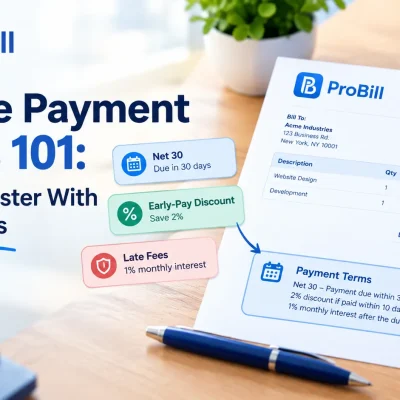
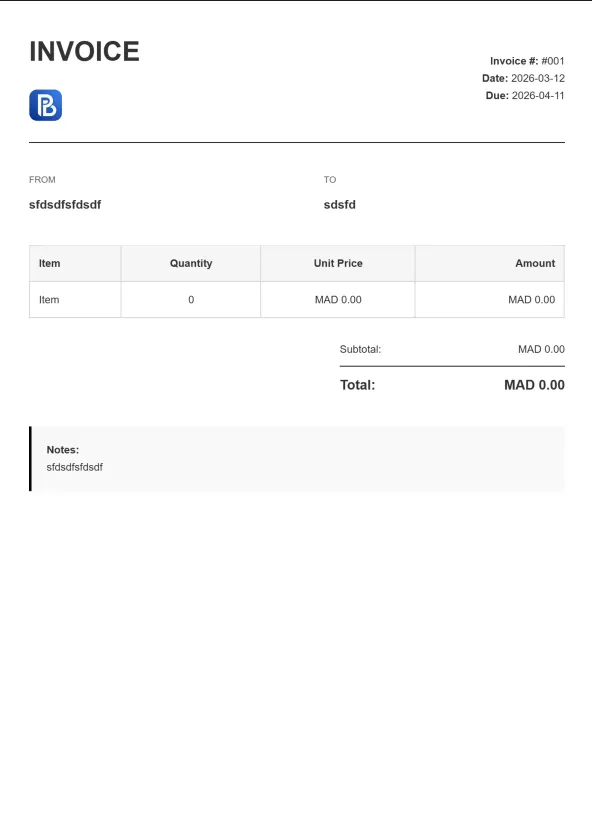
2. Standardize supplier submissions with branded invoice templates; steer occasional vendors to the free invoice generator to enforce the same data fields.
3. Sync item masters weekly so the price on every purchase order and invoice originates from one source of truth, eliminating the difference between invoice and purchase order amounts.
4. If mismatches surface, let AP staff use Create Invoice to resend a corrected claim rather than editing the original—preserving the audit trail and clarifying the difference between PO and invoice versions issued.
5. Train teams on what an invoice is via the concise explainer at what an invoice is to curb formatting errors that drive exceptions.
By automating these checkpoints, you slash manual review and ensure the purchase order and invoice pair stay in lockstep—a practical answer when coworkers ask, “what is the difference between purchase order and invoice accuracy checks?”
Compliance, Audit, and Record-Keeping Tips to Stay Audit-Ready
Auditors focus less on isolated slips than on systemic lapses that obscure the difference between a purchase order and an invoice record. Keep books spotless with these proactive habits:
• Document retention: Store digital POs until contract expiry and invoices for the statutory window (often seven years). Link every file to its PO so auditors instantly see the difference between purchase order and purchase invoice dates.
• Version control: Assign immutable numbers to each document. If a change is needed, create a revision rather than overwriting—critical for proving the difference between PO and invoice adjustments.
• Segregation of duties: Separate the staff who approve a PO from those who post the invoice, closing a fraud loophole the ACFE flags as a top risk.
• Tax readiness: Map VAT or sales-tax fields to specific GL codes and cross-reference local rules in our invoice resources by industry so region-specific nuances never slip through.
• Policy alignment: Clarify in your finance manual what is the difference between purchase order and invoice documentation versus a invoice vs bill or invoice vs receipt so staff file each document correctly.
Implementation checklist:
1. Tag documents by category—standard, progress, or credit—using the guide on types of invoices to streamline searches.
2. Encrypt archives and require multi-factor access; lost files obliterate evidence of the difference between purchase order and invoice approval steps.
3. Run quarterly self-audits with a random sample of transactions to confirm every purchase order and invoice link holds.
Following these controls delivers the transparency regulators expect and answers, once and for all, what is the difference between purchase order and invoice integrity versus mere paper pushing.
Frequently Asked Questions About Purchase Orders and Invoices
What is the difference between a purchase order and an invoice?
The main difference between a purchase order and an invoice is purpose and timing: a PO originates with the buyer to authorize spend, while an invoice comes from the seller to request payment. Because the purchase order and invoice serve opposite sides of the same transaction, the PO locks in terms and the invoice formalizes the receivable—details covered in depth at what an invoice is. In short, understanding the difference between purchase order and invoice documents prevents approval and cash-flow snags.
Is a purchase order legally binding without an invoice?
Yes. Once a supplier accepts the PO—by signature, email confirmation, or performance—it becomes a binding contract even if no invoice exists yet, as recognized under U.S. Uniform Commercial Code Article 2. The invoice later evidences the claim for money, so the difference between a purchase order and an invoice is enforceability versus settlement; see the nuances in our guide to invoice vs bill.
Can one invoice cover multiple purchase orders?
A single invoice can consolidate several POs when shipments or services overlap, but every referenced PO number must be listed to pass matching rules. Using standardized invoice templates or a free invoice generator keeps numbering consistent so any difference between PO and invoice amounts is easy to trace. Consolidated billing streamlines paperwork while still preserving the audit trail between each purchase order and invoice pair.
What is purchase order invoice matching, and why is it important?
Purchase order invoice matching—commonly the three-way match—checks that the PO, receipt, and invoice agree on price, quantity, and tax before payment. Firms in every sector (see our invoice resources by industry) rely on this control to prevent overbilling and duplicate payments. By surfacing any difference between invoice and purchase order data early, the process safeguards both cash and compliance.
How does the difference between purchase order and purchase invoice affect accounting entries?
A PO records a commitment or encumbrance but does not yet create a liability, whereas a verified purchase invoice debits the expense and credits accounts payable. This sequencing highlights the difference between purchase order and purchase invoice entries and why controllers bucket documents into distinct types of invoices for recognition. Accurate classification ensures the general ledger mirrors real obligations.
When should I issue a purchase order vs invoice in international trade?
In cross-border deals, the importer sends a purchase order first to cement price, Incoterms, and customs requirements; the exporter issues the commercial invoice once the goods ship. Banks and brokers compare the purchase order and invoice line by line, so any difference between purchase order and invoice wording can delay letters of credit. Use Create Invoice to generate compliant export forms and review the critical invoice vs receipt distinctions at invoice vs receipt to keep customs clearances smooth.