Skip to content

Understanding the Different Types of Invoices
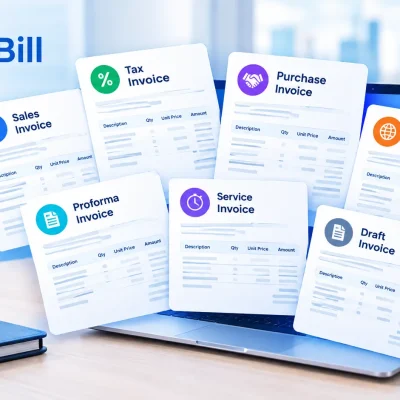
Choosing the right invoice format is easier when you have the right tools at hand. Whether you leverage our Create Invoice wizard, a free invoice generator, or download ready-made invoice templates, matching the document to the situation keeps payments predictable and books tidy. The quick guide below explains why invoice classification directly affects cash flow, then compares eight formats used across industries—each one linked to deeper invoice resources by industry for further reading.
What is an invoice and why does classification matter for cash flow?
An invoice is a formal request for payment—see what an invoice is for the full definition—but not every invoice triggers the same accounting treatment or customer response. Classifying each invoice correctly determines:
- Revenue recognition timeline. A draft invoice signals work in progress, while a final invoice closes the sale and can be booked as earned income.
- Tax liability. A tax invoice contains the fields auditors require; mis-classifying it risks under- or over-paying VAT or GST.
- Customer urgency. Proforma invoice totals are informative, but only a sales invoice starts the due-date clock, preventing the “I didn’t know it was payable” excuse.
- Purchasing decisions. A buyer’s purchase invoice feeds directly into their accounts-payable pipeline, helping both sides forecast cash flow.
- Compliance for cross-border shipments. Without the correct commercial invoice, customs can detain goods, delaying receipt and payment.
Treating every invoice the same muddies these differences, leading to inaccurate AR aging, poor tax estimates, and avoidable cash-flow gaps—issues explored further in our article on what an open invoice is.
Quick comparison table of eight common invoice formats
| Invoice format | Typical use-case | Key data included | When to send | Learn more |
|---|---|---|---|---|
| sales invoices | Bill customers for products already delivered | Item list, unit price, payment terms | Immediately after shipment | what a sales invoice is |
| purchase invoice | Record goods a business buys from vendors | PO reference, quantity received, supplier details | Upon receipt of supplier bill | what a purchase invoice is |
| tax invoice | Claim or charge indirect taxes such as VAT/GST | Tax registration number, tax rate, taxable value | As required by tax law (often within 30 days) | what a tax invoice is |
| service invoice | Bill hourly or milestone-based professional work | Hours, rate, service description | At project milestones or month-end | — |
| commercial invoice | Clear goods through customs | HS codes, country of origin, Incoterms | Before international shipment | commercial vs proforma invoice |
| proforma invoice | Provide an estimated price before work starts | Project scope, tentative total, validity date | Pre-project or pre-shipment | same link as above |
| draft invoice | Preliminary document for internal review | All fields marked “Draft,” no invoice number | Prior to client approval | — |
| final invoice | Definitive, numbered billing statement | Invoice number, due date, final balance | After project completion or delivery | — |
Use the table to pick the correct invoice each time and keep money moving without surprises.
Core Transaction Documents: Sales, Purchase & Commercial Invoices
Getting the timing and content of core transaction documents right—especially sales invoices, a matching purchase invoice, and the export-ready commercial invoice—keeps money moving and goods flowing. If you’re unsure which format to raise, our Create Invoice wizard, free invoice generator, and downloadable invoice templates guide you step-by-step while staying compliant with what an invoice is. For sector-specific nuances, check the continuously updated invoice resources by industry.
When to issue a sales invoice vs. a purchase invoice
A transaction produces two mirror documents: the seller’s sales invoices and the buyer’s purchase invoice. Issuing them at the right moment prevents disputes and shortens days sales outstanding.
- Seller ships goods or delivers a service.
- Any remaining draft invoice is converted into a final invoice with a sequential number.
- That definitive document becomes the seller’s legally enforceable sales invoice—see what a sales invoice is for the mandatory data list.
- The customer records the same paper as a purchase invoice (details in what a purchase invoice is) and books it into accounts payable.
Key distinctions:
• Trigger: The seller controls when sales invoices go out; the buyer logs the purchase invoice only after receipt.
• Revenue vs. expense: Sales side accelerates income recognition, while the purchase side schedules cash outflow.
• Tax handling: If indirect tax applies, the seller may also produce a tax invoice; the buyer uses those figures for recoverable input VAT/GST, following rules outlined in what a tax invoice is.
Tip: Convert a service invoice or proforma invoice into a numbered sales invoice as soon as Milestone X is complete. Delaying creates an unnecessary open invoice exposure—see what an open invoice is for the cash-flow risks.
How a commercial invoice streamlines international trade shipments
A commercial invoice is the customs-clearing counterpart to domestic sales invoices and must travel with every cross-border consignment. Unlike a simple packing list, it combines product descriptions, HS codes, Incoterms, and values that border agents use to calculate duties. Generating it alongside the final sales paperwork—with the help of our HS-code-enabled invoice templates or the instant fields in the free invoice generator—avoids costly holds.
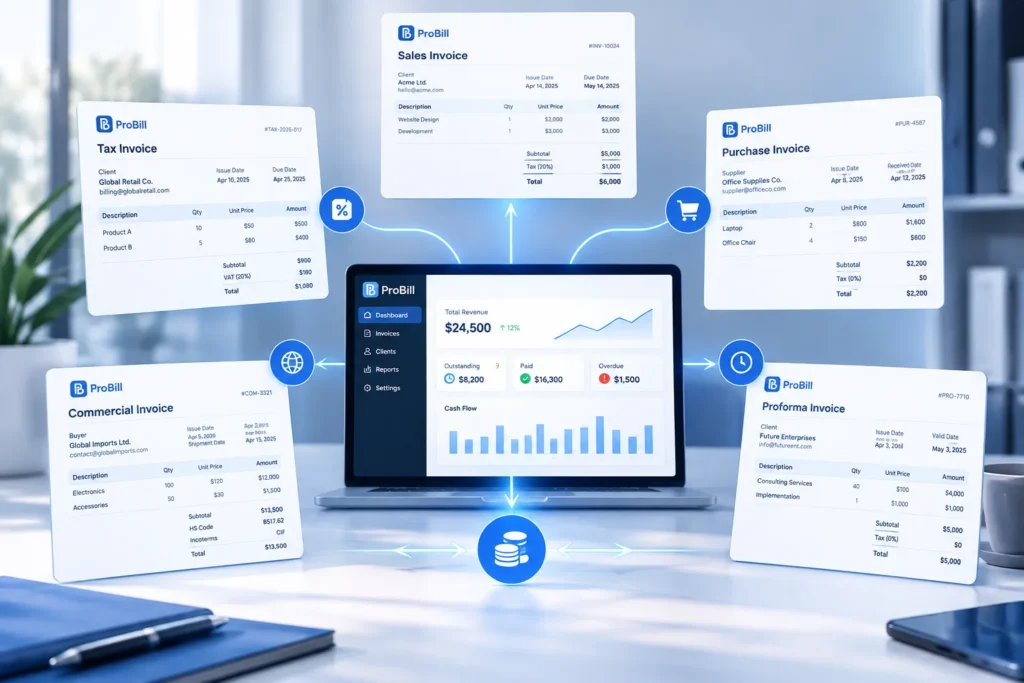
Three ways the document accelerates transit:
• One source of truth: Exporters, importers, freight forwarders, and customs officials all reference the same commercial invoice, cutting re-keying errors.
• Automated compliance checks: EDI platforms read the HS code and country-of-origin fields to flag sanctions or licensing needs before the truck even moves.
• Duty estimation: Buyers can pre-fund duties and taxes, reducing warehouse time on arrival.
Don’t confuse a commercial invoice with the informative proforma invoice issued during price negotiations; the formal differences are detailed in our guide to commercial vs proforma invoice. If your shipment includes dutiable repairs, include a service invoice breakdown so customs can apply the right valuation method.
Service, Tax & Proforma Invoices: Staying Compliant and Professional
Selecting the right document is only half the battle; the other half is issuing it in a way that keeps auditors, customers, and cash flow happy. Whether you raise a service invoice for consulting hours or a legally binding tax invoice for VAT, using the Create Invoice wizard or adaptable invoice templates ensures every field lands where regulators expect—no frantic edits at month-end. If you ever wonder why these tiny details matter, revisit what an invoice is for the compliance backstory.
Must-have elements of a compliant tax invoice
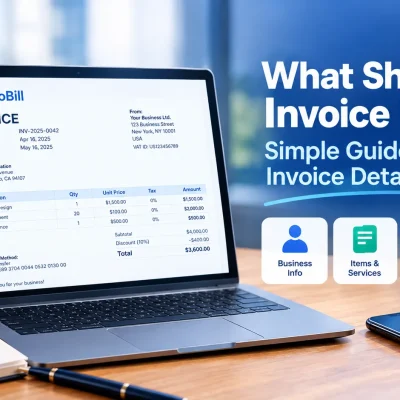
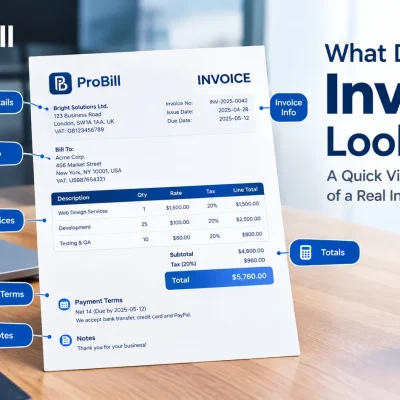
A single missing item can invalidate a tax invoice, delaying input-tax credits and risking penalties. Confirm that every issue includes:
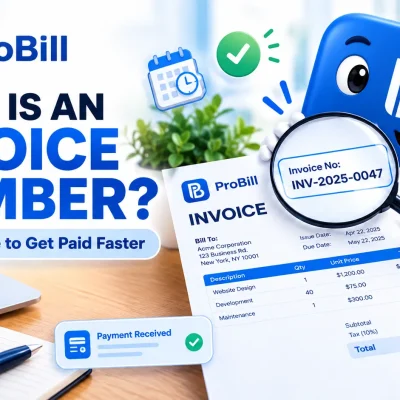
• Sequential invoice number that ties back to your accounting software.
• Supplier and customer legal names, full addresses, and tax registration IDs.
• Clear description of goods or services, matched to any linked sales invoices or commercial invoice for the same shipment.
• Taxable value, applicable VAT/GST rate, and the exact tax amount per line, not just the grand total.
• Currency, issue date, and payment terms that mirror the related purchase invoice your customer will book.
• Optional—but audit-friendly—reference to the underlying draft invoice or quote.
Use the real-time validation in the free invoice generator to auto-populate rates, then compare with what a tax invoice is before hitting send. For cross-border sales, align HS codes with the matching commercial invoice to satisfy customs and local authorities such as HMRC’s Making Tax Digital rules (https://www.gov.uk).
Turning a proforma into a service invoice without double work
Upgrading a proforma invoice to a billable service invoice should take minutes, not hours:
- Duplicate the proforma in your tool of choice. In commercial vs proforma invoice you’ll see why the initial document carries no accounting weight.
- Replace the provisional heading with “Service Invoice” and assign the next sequential number; this converts your quotation-style draft into a final invoice.
- Pull time-tracking or milestone data straight into line items, eliminating manual re-entry.
- Add the tax section only if the engagement now meets tax invoice thresholds; otherwise keep the layout lean.
- Reconfirm payment terms so the due date aligns with project completion—doing so prevents an unnoticed open invoice, a risk explored in what an open invoice is.
- Send the document from within the platform so buyer systems ingest it as a purchase invoice, closing the loop.
Industry-specific wording—IT, legal, repair, or creative—is available inside our invoice resources by industry to keep each converted file contextually sharp.
Draft vs. Final Invoice: Preventing Payment Delays
When to send a draft invoice for client review
Issuing a draft invoice early gives customers a chance to verify quantities, rates, and line-item taxes before the due-date clock starts—an approach endorsed by HMRC’s guidance on invoicing accuracy (https://www.gov.uk). Use the Create Invoice wizard or the free invoice generator to flag the document clearly as “Draft” so it never posts to revenue prematurely, yet still shows every field required by the formal definition of what an invoice is.
Send a draft invoice when:
• A project-based service invoice will exceed the original estimate and you want written approval before work continues.
• A large shipment needs a pre-clearance commercial invoice; sharing the draft lets the freight forwarder confirm HS codes.
• Recurring retainers involve fluctuating hours—previewing the next cycle’s charges avoids disputes and keeps sales invoices clean.
• The buyer must raise an internal purchase order; your draft becomes their placeholder purchase invoice without starting the payment term.
• Indirect taxes vary by jurisdiction; a draft lets the customer verify VAT/GST details that will later appear on the binding tax invoice.
Attach any change log directly in the PDF generated from our invoice templates so comments stay in one place. For sector-specific nuances—construction progress bills, IT retainers, or creative milestones—tap the curated invoice resources by industry library. Capturing sign-off at this stage eliminates “I never agreed to that amount” pushback and shortens the time an amount sits as an open invoice.
Converting a draft into a final invoice in your accounting software
Turning a draft invoice into a final invoice is more than a status toggle; it legally crystallizes revenue and starts the statutory payment countdown. Most cloud platforms mirror the workflow below, and each step can be completed inside Create Invoice just as easily:

- Open the draft record and double-check client comments have been resolved—especially on scope creep flagged in an earlier proforma invoice (see the comparison in commercial vs proforma invoice).
- Replace the “Draft” tag with the next sequential number so the document now qualifies as a compliant sales invoice (guide: what a sales invoice is).
- If indirect tax applies, auto-populate the VAT/GST fields to meet every line-item rule in what a tax invoice is.
- Link any matching purchase order so the customer’s system can book the mirrored purchase invoice without manual keying (details in what a purchase invoice is).
- For cross-border deals, clone the data into the shipment’s commercial invoice to keep customs values consistent and avoid clearance delays.
- Hit “Send & Record.” The software emails the PDF, timestamps delivery, and moves the balance from WIP to accounts receivable—preventing the limbo that creates an aging service invoice or a forgotten balance. If payment terms start today, the due date appears automatically, reducing the chance of a future payment chase outlined in what an open invoice is.
Following this sequence means each draft invoice matures into a final invoice with zero retyping, no compliance gaps, and—most importantly—fewer excuses for late payment.
Frequently Asked Questions About Invoice Types
Which type of invoice is best for freelancers?
For most freelancers, a service invoice is the most flexible of all invoice types because it can list hourly work, milestones, or retainers while remaining concise. Our Create Invoice tool and downloadable invoice templates auto-fill hours, rates, and tax fields so you send accurate sales invoices without extra admin. If the client wants a quote first, issue a proforma invoice and convert it later to avoid duplicate numbering.
Can I use a proforma invoice as a legal substitute for a sales invoice?
No—although both invoice types outline price and scope, a proforma invoice is only an estimate and cannot be booked as revenue or expense. You must follow up with a numbered sales document; see the detailed comparison in commercial vs proforma invoice and the legal data list in what a sales invoice is. Converting the proforma to a final invoice keeps tax and due-date rules intact.
How does a tax invoice differ from a commercial invoice?
A tax invoice proves VAT or GST liability, while a commercial invoice supports customs valuation for exported goods—two distinct invoice types serving different regulators. The required tax registration numbers and rates are spelled out in what a tax invoice is, whereas a commercial invoice must show HS codes and Incoterms to clear borders. Mixing them up can trigger audits or shipment delays.
Is a purchase invoice the same as a bill?
In accounting, a purchase invoice and a bill describe the same document from the buyer’s perspective; both record what you owe a supplier. The distinction only matters when matching the supplier’s sales invoices to your payables, a process explained in what a purchase invoice is. Regardless of label, enter it promptly so cash-flow forecasts reflect all invoice types outstanding.
Do I need to issue a final invoice after a draft?
Yes. A draft invoice helps clients verify charges, but only a final invoice starts the statutory payment clock and locks revenue in your ledger. Skipping this step leaves an open balance that can be disputed later; always upgrade the draft invoice to avoid an aging receivable.
What details must appear on an international service invoice?
An international service invoice—one of the specialized invoice types—should include service description, hours or milestones, currency, client tax ID, and the supplier’s registration number, plus any withholding-tax clause. Use the free invoice generator or browse invoice resources by industry to insert country-specific notes alongside optional commercial invoice references when physical deliverables accompany the work. Including these fields keeps both tax authorities and clients satisfied and speeds cross-border payment.